Infrared vs Traditional Sauna: Heat, Power, Warm-Up and Cost Compared
We may earn a commission if you buy through links on this page; it doesn't change what we list or how we describe it. How this works
A traditional sauna heats the air and a pile of stones, runs hotter, and lets you raise the humidity by pouring water on the stones. An infrared sauna warms you with radiant panels while the air stays cooler, uses no water, and draws less power. For two people, Clearlight’s Sanctuary Outdoor 2 infrared is rated at 2.32 kW, against a 6 kW heater in Almost Heaven’s 2-person Salem barrel. Warm-up times look similar but aim at different air temperatures. Almost Heaven says its saunas reach 165°F in 30–40 minutes and 185°F in under an hour. Sunlighten says to allow 45–60 minutes, and that its cabin air isn’t meant to reach its 150.8°F preset. This site doesn’t give medical advice. If you’re pregnant or have a health condition, ask your doctor before using a sauna.
How each one heats
The North American Sauna Society describes a sauna as a room “heated to about 150 to 195 (F) degrees,” where temperature and humidity “can be controlled with sprinkling water on the rocks in the heater/stove.” It calls an infrared room “Not a traditional Finnish sauna,” because its emitters send heat “directly to the person’s body—rather than heating the air, or stones,” and “There is no water (no steam) used in the infrared rooms.”
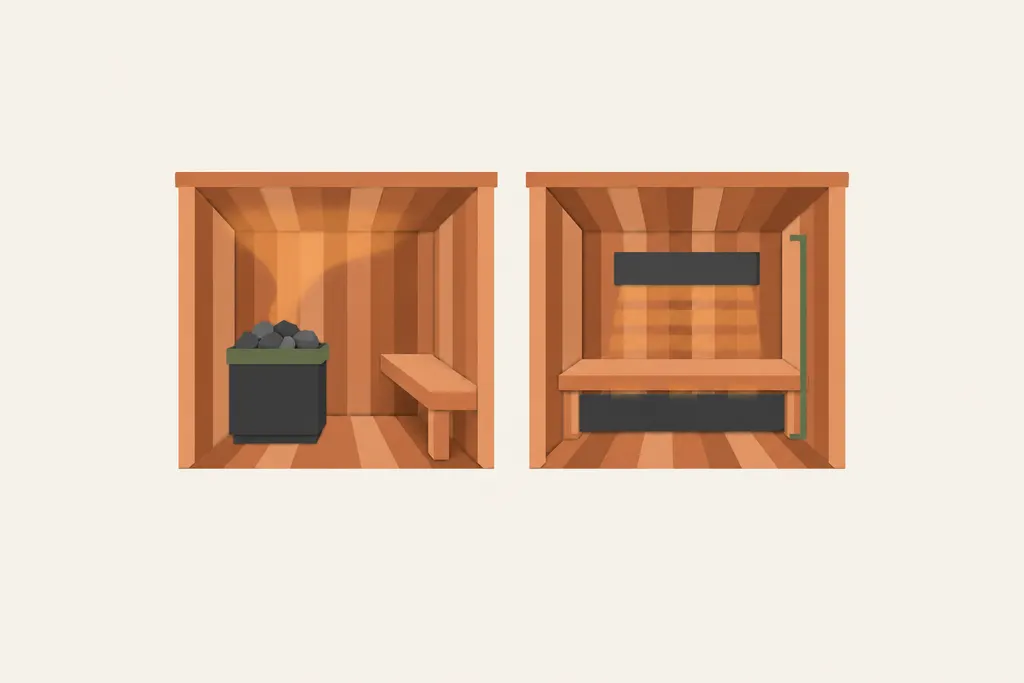
That difference shows up in the manuals. Almost Heaven’s manual for its Harvia Wall heater says “You have the option to pour water onto the stones to generate steam,” and “For most sauna users, a ladle full of water is sufficient.” Sunlighten’s infrared manual says the opposite for its panels: “Keep all liquids away from the heating panels, electronics, and interior wood.” Don’t pour water in an infrared cabin.
Temperature and humidity
The sources measure different things, so each gets its own column:
| Traditional | Infrared | |
|---|---|---|
| North American Sauna Society | about 150–195°F; humidity from 10% (no water) to 60% or more | no water, no steam |
| Almost Heaven chart, Pinnacle page | electric: 150–195°F, 10–20% humidity; wood: 160–200°F, variable humidity | 120–140°F, low humidity |
| Almost Heaven chart, Hinton page | dry heat (electric): 158–212°F, 10–20% humidity; wood: 158–230°F | 104–140°F |
| Clearlight FAQ | “can reach up to 90.5 degrees Celsius” (about 195°F) | “usually between 48.8-65.5 degrees Celsius” (about 120–150°F) |
| Sunlighten Signature manual | — | controls preset to 150.8°F (66°C); cabin air not meant to reach it |
| Fixr (2025) | 158–212°F, 10–20% relative humidity | — |
Almost Heaven’s two pages give different ranges for the same heat types, so we show both. Sunlighten’s manual says the cabin air “is not intended to reach” the preset, because the design is “based on the infrared wavelength and not cabin temperature.” The how hot should a sauna be page covers temperature settings.
Warm-up time
| Source | Traditional | Infrared |
|---|---|---|
| Makers | Almost Heaven heater FAQ: “Typically, our saunas will heat to 165°F in 30–40 minutes and to 185° in less than 60.” | Sunlighten Signature manual: “Allow the sauna to warm-up for 45-60 minutes. The sauna heats up at an average of 1 degree per minute.” Cabin air isn’t meant to reach the 150.8°F preset. |
| Fixr FAQ (2025) | “about 15-30 minutes” | “10 minutes” |
These aren’t times to the same temperature: Almost Heaven counts to 165–185°F, while Sunlighten’s cabin air stays below 150.8°F. The makers’ figures and Fixr’s don’t match either. We’d plan on the makers’ figures. Sunlighten also notes that a sauna placed outside or in an unheated garage may need more warm-up time.
Electrical requirements
This is the biggest practical difference. Figures are from each maker’s spec sheet or product page:
| Model | Type | Power per maker |
|---|---|---|
| Sunlighten Signature I (1 person, indoor) | Infrared | 120 V, 1,350 W, 20 A; “Dedicated 120V 20A circuit required” |
| Almost Heaven Hinton (2–3 people, indoor) | Infrared | “120V, 20 amp dedicated outlet” |
| Clearlight Sanctuary Outdoor 2 | Infrared | 240 V, 2,320 W, 9.7 A; plugs into a 240 V outlet |
| Clearlight Sanctuary Outdoor 5 | Infrared | 240 V, 3,600 W, 15 A; plugs into a 240 V outlet |
| Almost Heaven Salem (2 people) and Pinnacle (4 people) barrels | Traditional, 6 kW | “240V, 30-amp requirement, hardwire connect” |
So infrared doesn’t mean any household outlet will do. The indoor models above want their own 120 V, 20 A circuit, and the outdoor Clearlight models want a 240 V outlet. Sunlighten says to plug “directly into wall outlet; not a power strip, extension cord or converter,” and to have “a certified electrician install the dedicated outlet.” A traditional heater is hardwired on its own 240 V circuit. Either way, a licensed electrician confirms the circuit and pulls the permit. Details are in sauna electrical requirements.
Purchase and running costs
Fixr’s installed prices for 2–4 person saunas: infrared $2,000–$12,000, electric traditional $3,000–$5,000. Its monthly running costs: infrared $15–$20, electric $25–$30. Sunlighten’s manual puts its Signature at “typically $.20-.50” per hour, varying “with the model and local utility cost.”
You can check the upper limit yourself. At the U.S. residential average of 18.16 cents per kWh (EIA, August 2026), a heater running at full power for one hour costs about $1.09 at 6 kW (the Salem) and about $0.42 at 2.32 kW (the Sanctuary Outdoor 2), our arithmetic. Thermostats cycle the power, so real use is lower. The sauna calculator runs the numbers for your heater, sessions and local rate.
Listed prices on Almost Heaven’s site, checked Nov 1, 2026: the Hinton 2–3 person infrared cabin (indoor) at $6,840, and the Salem 2-person outdoor barrel with a 6 kW heater at $4,485. These are different products for different spots, and prices change. Clearlight doesn’t list a price for its outdoor models; the page says “Get Pricing.”
Outdoor use
Traditional barrels and cabins are built for the yard. Almost Heaven’s barrel manual says its barrel “is designed for outdoor use.” Infrared depends on the model:
- Clearlight sells outdoor versions, the Sanctuary Outdoor 2 and 5, with a weather-resistant exterior finish, a roof cap and a sauna cover. They weigh 765 and 1,050 lbs; check Clearlight’s install instructions for the base they need. See sauna foundation options.
- Sunlighten says its saunas “aren’t designed to be placed outdoors.” If you put one outside anyway, it “must have a sauna cover for the warranty to be honored.” Its manual also asks for drainage “so that water cannot pool around the base.”
- Almost Heaven’s Hinton infrared is an indoor model that, in the company’s words, installs “using your existing flooring.”
How to choose
- You want steam, air around 165–185°F, and a wood or electric heater on stones: traditional. Plan a 240 V circuit sized to the heater manual.
- You want lower air temperature and lower power draw, and you have a spot indoors or a model rated for outdoors: infrared. Check the circuit the spec sheet asks for, and check whether the warranty allows outdoor use.
- You want both: some makers sell infrared rooms as well as traditional saunas; check the spec sheet for the power each heater needs.
For a traditional outdoor build, compare barrel and cabin saunas next.
Sizing a heater or pricing a setup? Run the Sauna Planner — volume, kW, breaker and cost in one place.
Illustrations on this page are AI-generated to help you picture the situation. They are not photos of real homes, jobs or people.
Sources
- North American Sauna Society — Sauna Types (© 2026, accessed Nov 1, 2026)
- North American Sauna Society — Design Guidelines (© 2026, accessed Nov 1, 2026)
- Sunlighten — Signature Owner's Manual (version 10212025), pp. 4–5, 10, 13–14
- Sunlighten — Signature I spec sheet (Doc# 09142026)
- Sunlighten — Signature infrared saunas, collection page with outdoor-use note (accessed Nov 1, 2026)
- Clearlight — Sanctuary Outdoor 2 Infrared Sauna, specifications (accessed Nov 1, 2026)
- Clearlight — Sanctuary Outdoor 5 Infrared Sauna, specifications and FAQ (accessed Nov 1, 2026)
- Almost Heaven Saunas — Pinnacle 4 Person Barrel Sauna, specifications and heater comparison chart (checked Nov 1, 2026)
- Almost Heaven Saunas — Salem 2 Person Barrel Sauna, specifications and price (checked Nov 1, 2026)
- Almost Heaven Saunas — Hinton 2-3 Person Infrared Sauna, specifications, price and heat-type chart (checked Nov 1, 2026)
- Almost Heaven Saunas — Barrel Sauna Installation & Owner's Manual (9-2024), p. 3
- Almost Heaven Saunas — Pro 20 Kit with Chimney page, heater FAQ on heat-up time and standard heater (checked Nov 1, 2026)
- Almost Heaven Saunas — Wall Heater Installation Manual (Harvia The Wall heater), p. 4
- Fixr — Cost to Install a Sauna (updated Jan 31, 2025)
- U.S. EIA — Electric Power Monthly, Table 5.6.A, residential average price, August 2026 (released Oct 2026)
Updated 2026-11-02
Safety and permits
A sauna heater needs its own circuit sized to the maker's manual — have a licensed electrician wire it and pull the permit. Wood-burning stoves need the clearances and chimney in the stove's manual and local code approval. Before digging for a foundation, call 811. This site doesn't give medical advice: if you're pregnant or have a health condition, ask your doctor before using a sauna.