Wood-Burning vs Electric Sauna: Heat-Up, Running Cost, Chimney vs Circuit
We may earn a commission if you buy through links on this page; it doesn't change what we list or how we describe it. How this works
An electric heater needs a dedicated 240-volt circuit, holds a set temperature on its own, and uses about $2–$3 of electricity for a two-hour session with a 6–8 kW heater at full power, at the U.S. average rate (our estimate below). A wood-burning stove needs no power, but it needs a chimney, clearances to anything combustible, a sauna big enough for it, and someone to tend the fire. It also adds to the kit price. On one Almost Heaven cabin, the version with a wood stove kit is listed at $4,284 more than the one with the basic electric heater (our arithmetic). Running costs come out close: Fixr puts wood at $20–$40 a month and electric at $25–$30.
Heat-up time and control
None of the sources we read gives a heat-up time for a wood stove specifically. Almost Heaven’s heater FAQ (on its Pro 20 wood stove page) says “Typically, our saunas will heat to 165°F in 30–40 minutes and to 185° in less than 60,” without saying whether that covers wood. Harvia’s stove manual ties heat-up to stove size: “A stove with too low output must be heated longer and more intensely, which will shorten the stove’s life span.”
On control, sources differ. Fixr says electric heaters “are easy to control with a thermostat,” and that wood heaters “do not offer you much control over the temperature.” The North American Sauna Society says that with a wood stove “the user can create the desired temperature by the [sic] controlling the rate of burn.” Harvia’s manual also says that “A good rule of thumb is that temperatures of over 100 ºC are too high in a sauna” (212°F) and warns: “Prolonged, intense heating may cause risk of fire!”
Running cost: firewood vs electricity
| Wood | Electric | |
|---|---|---|
| Fixr, cost to run per month (2025) | $20–$40 (“A pile of wood is around $10”) | $25–$30 |
| Our upper-limit estimate per session | depends on your wood price | 6 kW × 2 hours = 12 kWh, about $2.18; 8 kW, about $2.91 |
The electric line assumes the heater runs at full power for an hour of warm-up and an hour of use, at the U.S. residential average of 18.16 cents per kWh (EIA, August 2026). Thermostats cycle the power, so real use is lower. Plug in your own rate in the sauna calculator. On wood use, Harvia’s manual says that once the room is hot, “It takes only a couple of pieces of wood to maintain the bathing temperature.”
Installation: chimney vs 240V circuit
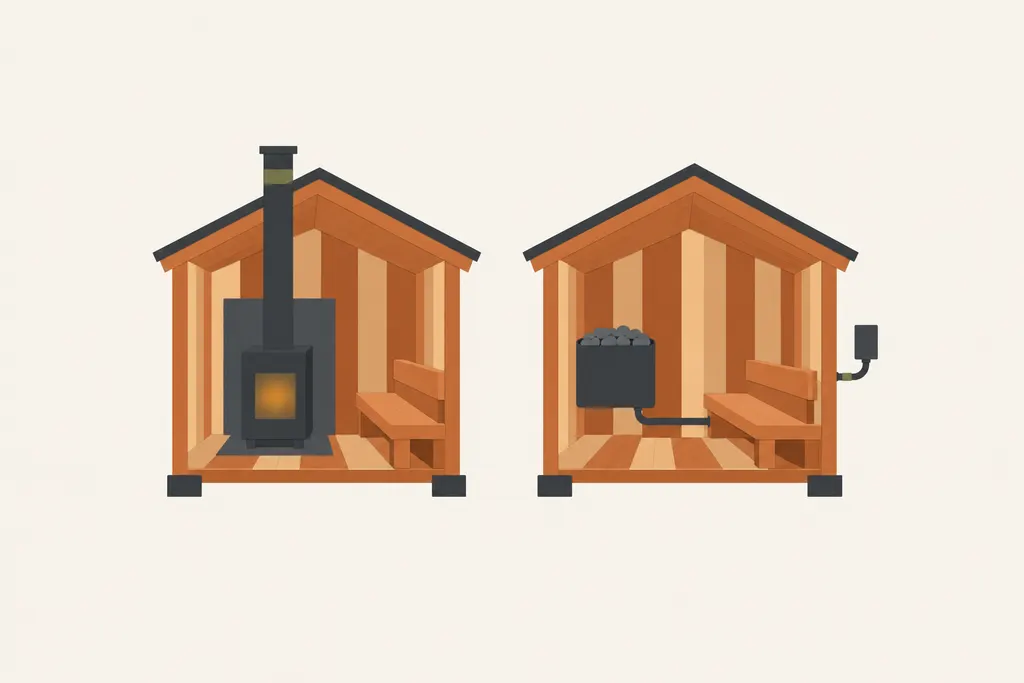
Electric. Almost Heaven lists the Allegheny cabin’s heater options as “8kW/9kW/10.5kW, 240V, 40/45/50-amp requirement, hard-wire connect.” Fixr puts “a 220-volt circuit in the home’s existing electrical panel” with “a 220-volt receptacle” near the sauna at $500–$800. Sauna heaters like these are hard-wired, so treat that as a rough figure. A licensed electrician confirms the circuit and pulls the permit. See sauna electrical requirements.
Wood. The stove kit comes with chimney parts. Almost Heaven’s M3 and Pro 20 kits each list a protective base, a protective surround, a 1500 mm stainless steel chimney section, a 1000 mm extension, a silicone chimney boot, a Harvia chimney assembly kit and sauna stones. Listed prices on Almost Heaven’s site, checked Nov 1, 2026 (prices change):
| Item | Listed price |
|---|---|
| M3 Heater Kit (wood) | $3,939 |
| Pro 20 Kit with Chimney (wood) | $4,612 |
| Allegheny 6-person cabin with 8 kW electric heater (dial controls) | $10,722 |
| Allegheny 6-person cabin with Pro 20 wood-burning kit | $15,006 |
Fixr’s installed prices for 2–4 person saunas are $3,000–$4,000 for wood-burning and $3,000–$5,000 for electric. Its heater-only prices run $260–$2,100 for wood and $600–$2,640 for electric. Those are Fixr’s ranges, not a quote.
Not every sauna can take a stove. Almost Heaven’s product-page FAQ says it allows wood heaters with “our cabins, cubes, and large diameter barrel saunas.” Harvia lists the M3 for rooms of 212–459 cubic feet, and Almost Heaven lists the Pro 20 for 282–706. LeisureCraft’s smallest cabin, the 141-cubic-foot Granby, has “No” in the “Wood Heater Available” row of its size table. Check your room volume against the stove’s minimum before you buy. See barrel vs cabin for typical volumes.
Clearances and safety requirements
Harvia’s M3 page lists these safety distances to combustible materials, with a note to “check the product manual for updated information before use”:
| Harvia M3 | Safety distance (combustible materials) |
|---|---|
| Front | 11.81 in |
| Behind | 11.81 in |
| Each side | 9.84 in |
| Ceiling | 3.94 ft |
These numbers are for one stove. Other models have their own. Harvia’s manual adds that “There shall be no electrical devices, wires or inflammable materials within the established safety distances,” that the stove “is not suitable for installation in a shared flue system,” and that “the local fire authorities in charge of approving the installations can provide more detailed information.” Follow the stove manual and your local building code for clearances, floor protection and the chimney, and ask your building department whether you need a permit. Fixr writes that an outdoor sauna needs a permit, but your local building department decides.
Carbon monoxide comes from burning fuel. The CPSC says CO “is produced by the incomplete burning of various fuels, including coal, wood, charcoal,” and advises that appliances be “installed and operated according to the manufacturer’s instructions and local building codes,” and adds: “Most appliances should be installed by qualified professionals.” It advises having the heating system “professionally inspected and serviced annually,” including chimneys and flues checked for “blockages, corrosion, partial and complete disconnections, and loose connections.” CPSC advises CO alarms that meet “the current UL 2034 safety standard” on every level of the home and outside sleeping areas, and “does not recommend installing CO alarms in kitchens or above fuel-burning appliances.” Ask the stove maker and your building department whether and where a CO alarm belongs near your sauna.
Maintenance
Wood. Harvia’s manual says to empty the ash box before each firing, keep removed ash in a metal container away from anything combustible “as the removed ash may include hot embers,” and have the chimney and connection pipes “swept at regular intervals and especially if the stove has not been used in a long time.” LeisureCraft’s care guide adds: “remove ashes when completely cool and inspect the chimney and flue regularly,” and once a year, have the chimney “cleaned as required.”
Electric. Almost Heaven’s yearly task for any of its outdoor saunas is to “check the stones for any cracks or brittleness and rinse them off.” Its Harvia heaters carry a 1-year warranty on the heating elements and 5 years on other components. Stones need attention with both heater types; see sauna stones: types and how many.
Which one to pick
- Pick electric if you have, or can get, a 240 V circuit to the spot, you want to set a temperature and walk away, or your sauna is a small barrel below a stove’s minimum room size.
- Pick wood if there’s no power at the site, the sauna is big enough for the stove you want, and you’re ready for the chimney, clearances, permit and ash.
Ventilation matters with either heater; see sauna ventilation.
Sizing a heater or pricing a setup? Run the Sauna Planner — volume, kW, breaker and cost in one place.
Illustrations on this page are AI-generated to help you picture the situation. They are not photos of real homes, jobs or people.
Sources
- North American Sauna Society — Sauna Types (© 2026, accessed Nov 1, 2026)
- Harvia — Instructions for Installation and Use of Woodburning Stove (M1, M2, M3, 20 Pro and others; doc. Y05-0109-1), English section pp. 25–30, 32
- Harvia — Wood burning heater M3 (WKM3), technical data and safety distances (harvia.com, accessed Nov 1, 2026)
- Almost Heaven Saunas — M3 Heater Kit, contents and price (checked Nov 1, 2026)
- Almost Heaven Saunas — Pro 20 Kit with Chimney, contents, price and heater FAQ (checked Nov 1, 2026)
- Almost Heaven Saunas — Allegheny 6 Person Cabin Sauna, heater options and amps, prices and FAQ (checked Nov 1, 2026)
- LeisureCraft (Dundalk LeisureCraft) — CT Cabin Saunas: size table and care & maintenance guide (accessed Nov 1, 2026)
- Fixr — Cost to Install a Sauna (updated Jan 31, 2025)
- U.S. EIA — Electric Power Monthly, Table 5.6.A, residential average price, August 2026 (released Oct 2026)
- U.S. Consumer Product Safety Commission — Carbon Monoxide Questions and Answers (accessed Nov 1, 2026)
Updated 2026-11-02
Safety and permits
A sauna heater needs its own circuit sized to the maker's manual — have a licensed electrician wire it and pull the permit. Wood-burning stoves need the clearances and chimney in the stove's manual and local code approval. Before digging for a foundation, call 811. This site doesn't give medical advice: if you're pregnant or have a health condition, ask your doctor before using a sauna.